Physical Address
Delhi, India
Physical Address
Delhi, India

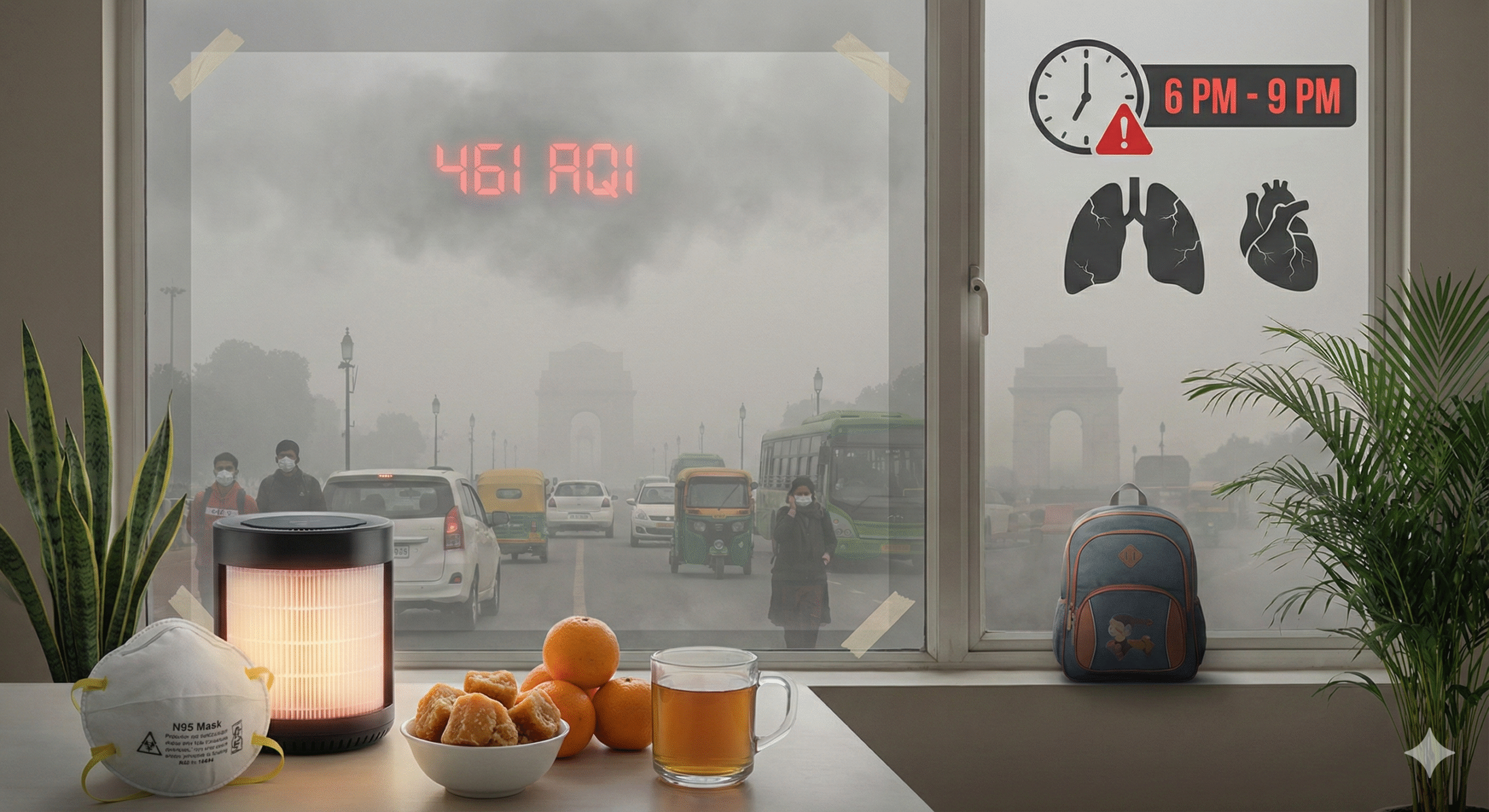
The AQI has breached 460, and a new "Evening Trap" phenomenon is making commutes deadlier than ever. From the "Safe Room" strategy to the truth about N95 masks, here is the essential survival protocol for December 2025 that every Delhiite needs to read right now.
The Smoke Signal: A Complete Survival Protocol for Delhi’s Air Crisis (Dec 2025) If you have lived in Delhi long enough, you know the taste. It hits the back of your throat the moment you step out the door in December—a distinct, metallic mix of dust, smoke, and burnt carbon that no amount of water seems to wash away.
As we move deeper into December 2025, the conversation in our living rooms has shifted. It is no longer just about the “smog” or the “fog.” It is about survival. With the AQI consistently breaching the ‘Severe’ category and hovering near the 460 mark, we are facing a public health challenge that requires more than just patience. It requires a military-grade strategy.
This is not a political rant or a list of complaints. This is a practical, science-backed guide on what is happening to our bodies right now, why the evenings are deadlier than the mornings, and how to minimize the damage for yourself and your family while we wait for the winds to change.
To survive the enemy, you must understand it. The term ‘AQI’ gets thrown around daily, but the real metric we need to watch is PM2.5. These are particles less than 2.5 micrometers in diameter—roughly 3% the width of a human hair.
Why does this size matter? Larger dust particles (PM10) get trapped in your nose or throat, causing coughing and irritation. PM2.5 is different. It is so microscopic that it behaves like a gas. It bypasses your body’s natural defenses entirely, traveling deep into the lungs and crossing the alveolar barrier into your bloodstream. Once in the blood, it circulates through your entire body, reaching the heart and brain.
CRITICAL UPDATE: The “Evening Trap” Phenomenon
New meteorological data indicates a significant spike in toxicity between 6:00 PM and 9:00 PM. This is due to the “Winter Inversion Effect.” During the day, the sun warms the ground, allowing air to rise and disperse pollutants. But as soon as the sun sets, the ground cools rapidly. A layer of cold air gets trapped under a layer of warm air, acting like a lid on a pot. This pushes all the vehicle emissions and smoke down to nose level.
Actionable Advice: If you are planning a run, a walk, or even a grocery trip, the evening is statistically the most dangerous time to be outdoors.
We tend to associate pollution only with respiratory issues like asthma or bronchitis. However, the medical community is now flagging broader systemic risks that are far more concerning.

Traffic emissions trapped by the winter inversion layer reduce visibility to near zero.
“I’m staying inside, so I’m safe.” This is the most dangerous misconception of the season.
Unless your home is hermetically sealed (which most Indian homes are not), the indoor air is often just as polluted as the outdoor air. In fact, it can be worse. Without proper ventilation, PM2.5 seeps in through door gaps and window cracks and stays trapped inside, mixing with cooking fumes and dust. This creates a “toxic soup” that you breathe while you sleep.
Since moving out of the city is not an option for most of us, we need to adapt our daily routines to mitigate exposure. Here is a four-step protocol to follow until the AQI drops below 200.
You cannot purify your whole house, but you can purify the room where you sleep. This ensures your lungs get 8 hours of recovery time every night.
If you drive, you are sitting in the middle of the pollution source. There is one button on your car’s dashboard that saves your life: the Air Recirculation Button (usually an icon of a car with a U-shaped arrow inside).
Ensure this is ALWAYS ON. If you pull fresh air from outside during a traffic jam, you are essentially sucking exhaust fumes directly into your cabin. If you travel by auto or bike, an N95 mask is mandatory, not optional.
You can fight inflammation from the inside.
Let’s be clear: A cloth mask, a handkerchief, or a surgical mask provides 0% protection against PM2.5 particles. They are too porous. You need an N95 or FFP2 rated mask.
The Fit Test: When you wear the mask, exhale sharply. If you feel air escaping into your eyes (fogging your glasses), the seal is not tight enough. Adjust the metal nose clip until the seal is perfect.
❌ Myth: “I should go for a morning walk to get fresh air.”
✅ Fact: In winter, early morning air is often the most toxic due to low temperature and low wind speed. Shift your workouts indoors or to the late afternoon (12 PM – 3 PM) when the sun helps disperse pollutants.
❌ Myth: “Sprinkling water outside my house reduces pollution.”
✅ Fact: This only settles the heavy dust (PM10) for a few minutes. It does nothing for the dangerous PM2.5 particles that stay suspended in the air.
❌ Myth: “I don’t need a purifier; I have plants.”
✅ Fact: To clean the air as effectively as one small machine, you would need about 10-15 large plants in a single room. Plants are great supplements, but they cannot replace technology in a Severe AQI crisis.
The Bottom Line
This season is undeniably difficult. It tests our patience, our mental health, and our physical resilience. But panic helps no one. Denial helps no one.
By understanding the science of what we are breathing and taking specific, calculated steps to reduce exposure, we can navigate this winter safely. This is not about living in fear; it is about living with awareness.
Stay indoors when possible, keep your masks handy, and look out for the vulnerable members of your community—the elderly, the children, and the security guards standing outside who don’t have the luxury of a “Safe Room.”