Physical Address
Delhi, India
Physical Address
Delhi, India

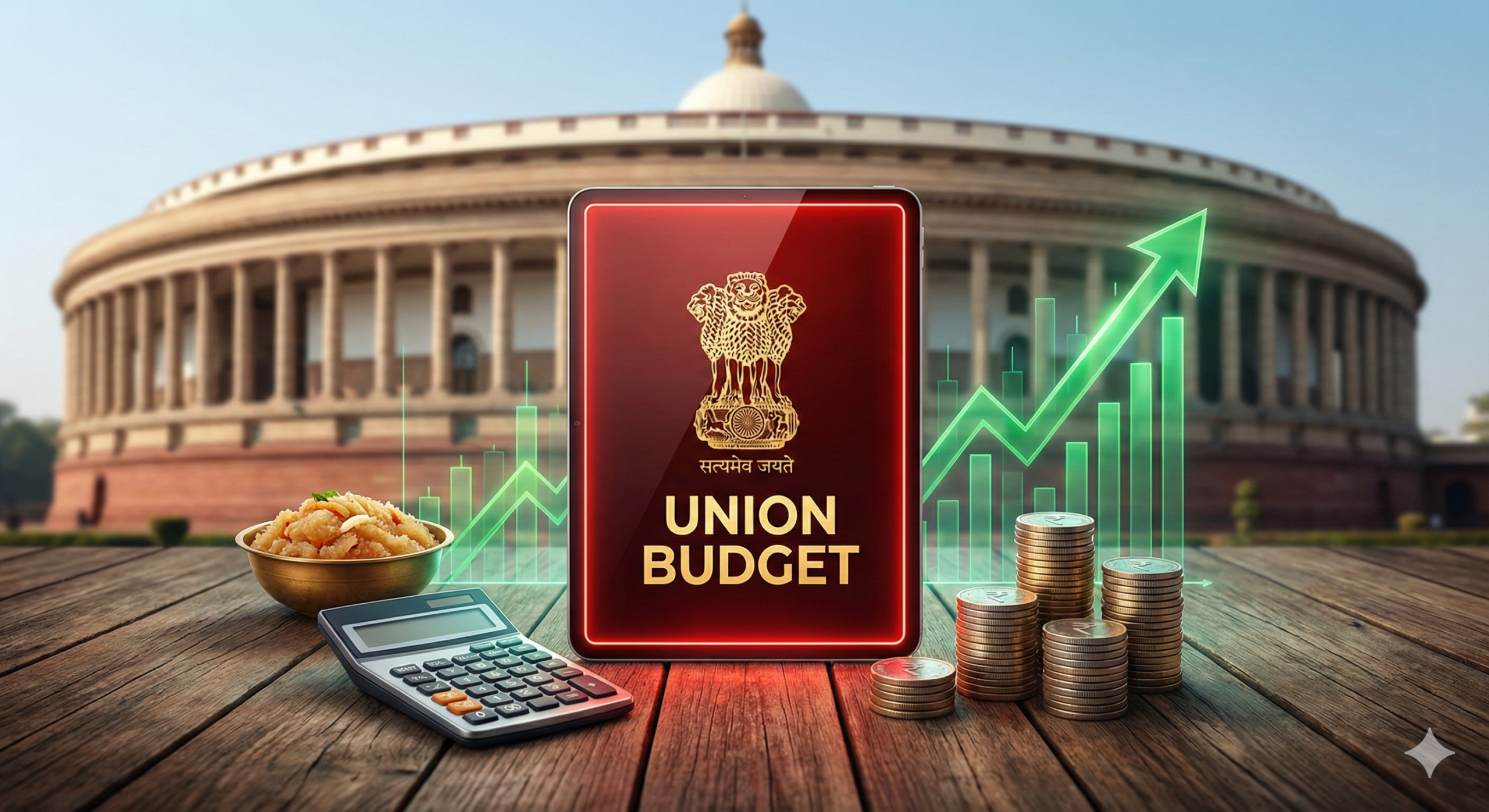
The Halwa has been stirred, and the North Block is in lockdown. As India awaits the Union Budget on February 1, 2026, the big question remains: Will the middle class finally get tax relief? From the history of the 'Briefcase' to the future of the 80C limit, here is your complete, jargon-free guide to the most important financial day of the year.
The Red Tablet Arrives: Will Budget 2026 Finally End the Middle Class ‘Tax Anxiety’?
Financial Analysis | January 27, 2026 | 15 Minute Read
It is that time of the year again. The “Halwa” has been stirred, the North Block is in lockdown, and 1.4 billion Indians are holding their breath.
On February 1, 2026, the Finance Minister will walk into Parliament holding a red tablet (the modern Bahi Khata) to present the Union Budget for FY 2026-27. For the stock market, it is a day of volatility. For the economist, it is a day of fiscal deficit numbers. But for the common man—the salaried employee sipping tea and checking news updates—it boils down to one simple question:
“Will my take-home salary increase, or will I just get more WhatsApp forwards?”
This year feels different. With the global economy stabilizing and India’s GDP growth projections looking robust, expectations are sky-high. Will the government finally raise the 80C limit that has been frozen since 2014? Will the “Old Tax Regime” finally be buried? Here is your complete, jargon-free guide to understanding the history, the hype, and the reality of Budget 2026.
[INSERT IMAGE: A split image showing the traditional leather briefcase from the 1990s vs. the modern red digital tablet used today, symbolizing the shift.]
From ‘Briefcase’ to ‘Bahi Khata’: The evolution of India’s financial statement.
Before we dive into the expectations, let’s understand the ritual. The word “Budget” comes from the French word bougette, meaning a leather bag.
India’s first budget was presented on April 7, 1860, by the East India Company. But the budgets that truly defined us were:
Trivia: Did you know the budget used to be presented at 5:00 PM? This was a relic of the British Raj (to match London time). It was only in 2001 that it was changed to 11:00 AM.
Let’s cut to the chase. The biggest grievance of the Indian taxpayer is the Section 80C limit.
The limit was set at ₹1.5 Lakh in 2014. Since then, inflation has increased the cost of living by over 60%, but the deduction limit remains the same.
Expectation for 2026: Analysts predict a hike to ₹2.5 Lakh. Why? because the government wants to encourage long-term savings in PF and infrastructure bonds. However, there is a catch—this might only apply if you stick to the “Old Regime.”
New vs. Old Regime:
The government has made it clear: they want a simplified tax structure without exemptions. In Budget 2026, we might see the “New Tax Regime” become even more attractive—perhaps by raising the basic exemption limit from ₹3 Lakh to ₹5 Lakh, effectively killing the Old Regime softly.
If you are an investor, ignore the tax slabs and look at the “Capex” (Capital Expenditure).
1. Infrastructure (Railways & Roads):
With the success of Vande Bharat trains, expect a massive allocation for “Vande Metro” and high-speed rail corridors. The government knows that visible infrastructure wins votes.
2. Defense (The ‘Border’ Effect):
In a geopolitical climate where movies like Border 2 are trending, the reality mirrors art. India’s focus on “Atmanirbhar Bharat” in defense is non-negotiable. Expect incentives for private players manufacturing drones and defense equipment in India.
3. Green Energy:
It is 2026. Climate change is no longer a debate; it is a summer reality. Look for heavy subsidies on Green Hydrogen and EV infrastructure. If you hold stocks in power or renewable energy, this is your section to watch.
While we look for tax cuts, foreign investors look at the Fiscal Deficit.
Simply put, this is the gap between what the government earns and what it spends. During the pandemic, this shot up. Now, the government is on a “Glide Path” to bring it down below 4.5% of GDP.
Why should you care?
If the fiscal deficit is too high, inflation rises (your vegetables get expensive) and loan interest rates go up (your EMI increases). A disciplined budget means a stable home loan rate for you in 2026.
A few days before the budget, a massive Kadhai (wok) of Halwa is prepared in the basement of the North Block. The Finance Minister serves it to the officials who are then “locked in.”
These officials stay in the basement, cut off from their families and the internet, until the budget is presented. It is one of the strictest quarantines in the world to prevent leaks. In an era of cyber-espionage, this old-school tradition is charmingly analog.
The Final Verdict
Budget 2026 is poised to be a balancing act. The government has to please the rural voter, comfort the urban taxpayer, and satisfy the foreign investor—all while keeping the deficit in check.
What should you do on February 1st?
Don’t panic-sell your stocks. Don’t start calculating your tax savings based on rumors. Watch the speech, look for the fine print, and remember: Good economics is often bad politics, and good politics is often bad economics. Let’s see which path the Finance Minister chooses this year.
Disclaimer: This article is for informational purposes only and does not constitute financial advice. Please consult a SEBI-registered investment advisor or a Chartered Accountant before making financial decisions.