Physical Address
Delhi, India
Physical Address
Delhi, India

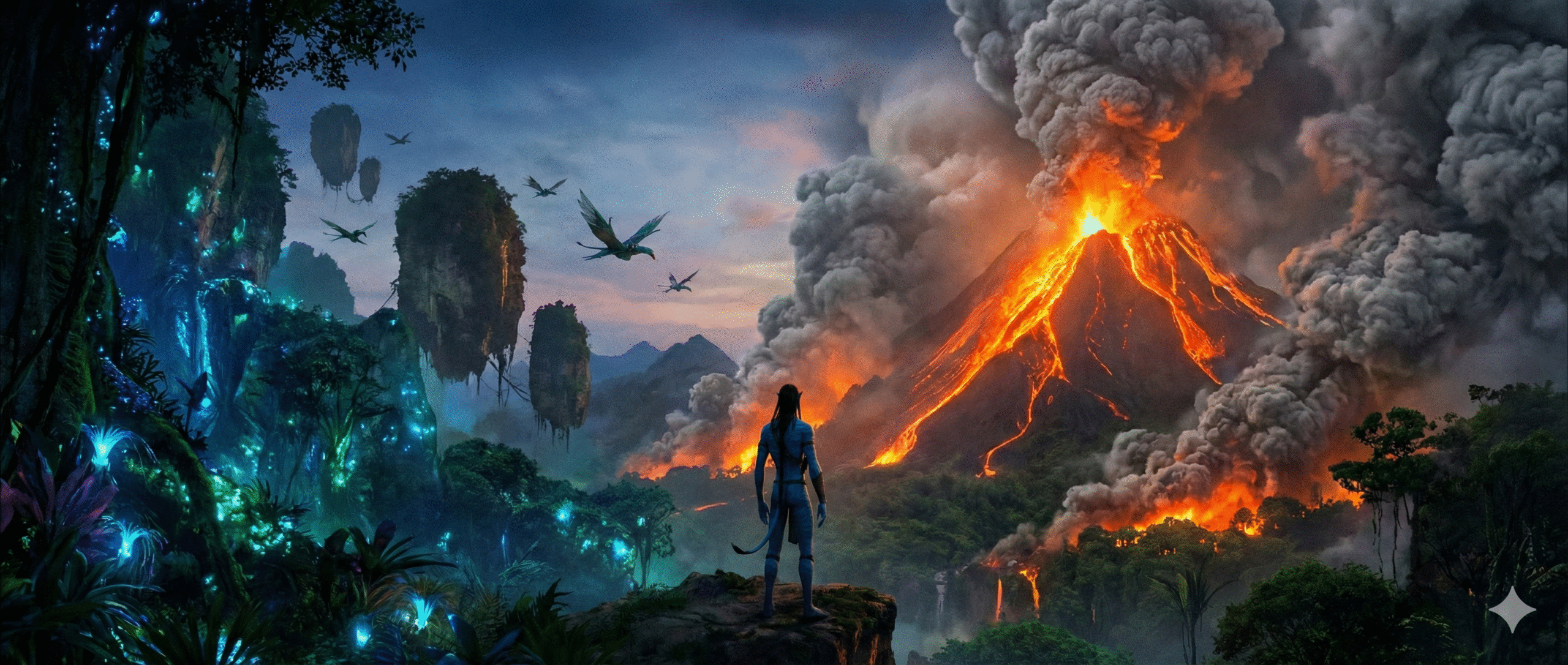
It’s here. Avatar: Fire and Ash has finally hit theaters, trading the blue oceans for red lava. From the terrifying new "Ash People" to Neytiri's descent into rage, here is our spoiler-free breakdown of why James Cameron’s third chapter destroys everything you thought you knew about Pandora.
Pandora Burns: Why ‘Avatar: Fire and Ash’ Is Not the Movie You Expected Movie Review & Analysis | December 19, 2025 | 14 Minute Read
James Cameron warned us. Years ago, he told us that the “Navi are not always the good guys.” But as Avatar: Fire and Ash hits theaters globally today, December 19, 2025, nothing could have prepared us for the sheer brutality of his vision.
For 16 years, we looked at Pandora as a bioluminescent paradise—a place of floating mountains and spiritual harmony. We wanted to live there. We wanted to plug our braids into the Tree of Souls and feel the heartbeat of Eywa.
Today, that dream is covered in soot. The third installment breaks the franchise’s formula in a way that is polarizing critics and stunning audiences. Gone are the soothing blues of the ocean; they have been replaced by the suffocating greys of volcanic ash and the violent reds of lava. This isn’t just a sequel; it is a deconstruction of everything we thought we knew about the Na’vi.
The biggest talking point of 2025 is undoubtedly the introduction of the Varang (played by a terrifyingly charismatic Oona Chaplin) and her “Ash People” (The Mangkwan Clan).
For two movies, we have been conditioned to believe that Na’vi = Good, Humans = Bad. Fire and Ash flips the board. The Ash People are not connected to Eywa through peace. They are connected through pain. Living in the volcanic wastelands of Pandora, they are physically distinct—paler, scarred, and aggressive.
Why are they so angry? The film reveals a crushing piece of lore: The Ash People believe Eywa abandoned them. Centuries ago, a volcanic eruption destroyed their home, and unlike the forest or reef clans, nature did not protect them. They had to survive by conquering nature, not bonding with it.
The Viral Twist: The alliance between Colonel Quaritch and Varang creates an “Axis of Evil” that puts the Sully family in a chokehold. Seeing Na’vi fight Na’vi with such visceral hatred—using human weapons provided by Quaritch—is a visual shock that audiences are struggling to process.
If The Way of Water was about protecting the family, Fire and Ash is about avenging it.
Zoe Saldaña delivers a performance that deserves serious Oscar buzz. Following the death of her eldest son Neteyam, Neytiri is no longer the spiritual warrior we knew. She is a mother consumed by rage. There are scenes in this movie where Neytiri scares the audience more than the villains do.
Her hatred for Spider (Quaritch’s human son) reaches a boiling point that makes for uncomfortable viewing. Cameron forces us to ask: At what point does justice become vengeance? When Neytiri looks at Spider, she doesn’t see a boy; she sees the species that killed her son. This tension drives a wedge between her and Jake, threatening to destroy the marriage that anchors the entire franchise.
One of the boldest moves Cameron made was replacing Jake Sully as the narrator. For the first time, we hear the story through the voice of Lo’ak.
This shifts the tone of the film entirely. Jake’s narration was always calculated, military, and protective. Lo’ak’s narration is reckless, emotional, and full of teenage angst. It gives the film a younger, more volatile energy. We aren’t seeing a war through the eyes of a General anymore; we are seeing it through the eyes of a soldier who doesn’t know if he will live to see tomorrow.
Technologically, this film is a flex. In 2022, we marveled at the water physics. In 2025, it is the particle physics of ash and fire.
The climax, set against an erupting volcano, is perhaps the most complex CGI sequence ever put to film. The way the light from the lava interacts with the sweat and ash on the Na’vi skin is hyper-realistic. The contrast of the bioluminescent forest against the dead, grey ash clouds creates a visual language that signifies the death of Pandora’s innocence.
You either hate him or you pity him. Spider (Jack Champion) is the emotional lightning rod of Fire and Ash.
Caught between a biological father who is a monster (Quaritch) and an adoptive mother who despises him (Neytiri), Spider’s arc is tragic. The film introduces a major plot device: Kiri helps Spider bond with a symbiotic organism that allows him to breathe Pandoran air without a mask.
This “gift” becomes a curse. Jake Sully is terrified that if the humans find out about this, they will reverse-engineer it to invade Pandora permanently without needing Avatars. This leads to a heartbreaking dilemma: Is Spider safer dead than alive?
The Good: Unmatched visuals, a terrifying new villain in Varang, and emotional stakes that feel genuine. The ending (which we won’t spoil) sets up Avatar 4: The Tulkun Rider perfectly.
The Bad: The runtime (3 hours 10 minutes) tests the bladder, and the relentless gloom might alienate fans who just wanted a “fun” return to Pandora.
Avatar: Fire and Ash proves that James Cameron isn’t just playing with tech; he is playing with our emotions. It is darker, meaner, and arguably better than its predecessors because it dares to burn down the paradise it built.
Are you watching it this weekend? Let us know if you think the Ash People are better villains than the RDA.