Physical Address
Delhi, India
Physical Address
Delhi, India

It was supposed to be a dream reunion. Instead, Lionel Messi's 2025 visit to Kolkata turned into a national embarrassment. From the "VIP selfie" mob to the breakdown of order at Salt Lake Stadium, here is an unflinching look at how India’s VIP culture ruined a historic moment.
The 20 Minutes That Shamed India: The Ugly Truth Behind Messi’s Kolkata Nightmare Opinion | December 15, 2025 | 9 Minute Read
We love to talk about “Atithi Devo Bhava” (The Guest is God). It is the tagline of our tourism campaigns and the core of our cultural identity. But on a humid Saturday in December 2025, inside the concrete cauldron of the Salt Lake Stadium, that slogan died a loud, public death.
Lionel Messi, the man who completed football, the World Cup winner, the undisputed Greatest of All Time, returned to the City of Joy after 14 years. It was supposed to be a moment of pure sporting romanticism. The script was simple: 85,000 screaming fans, a sea of blue and white, and a respectful tribute to a living legend.
Instead, what the world witnessed was a national embarrassment. It was a masterclass in mismanagement, a chaotic display of entitlement, and a brutal reminder that while India dreams of becoming a global superpower, our civic sense is still stuck in the dark ages. We didn’t celebrate Messi; we suffocated him.
To understand the magnitude of this failure, you have to look at the logistics. Tickets were sold for astronomical prices—ranging from ₹5,000 for the nosebleed sections to ₹25,000 for the “Gold” tiers. Fans traveled from Kerala, Kashmir, and Bangladesh. I spoke to a student who sold his laptop just to afford a ticket, hoping to see his idol for perhaps the last time.
They waited for hours in the crushing heat. The security checks were invasive. Water bottles were confiscated (a standard, yet cruel practice). But the fans endured it all for that one moment of magic.
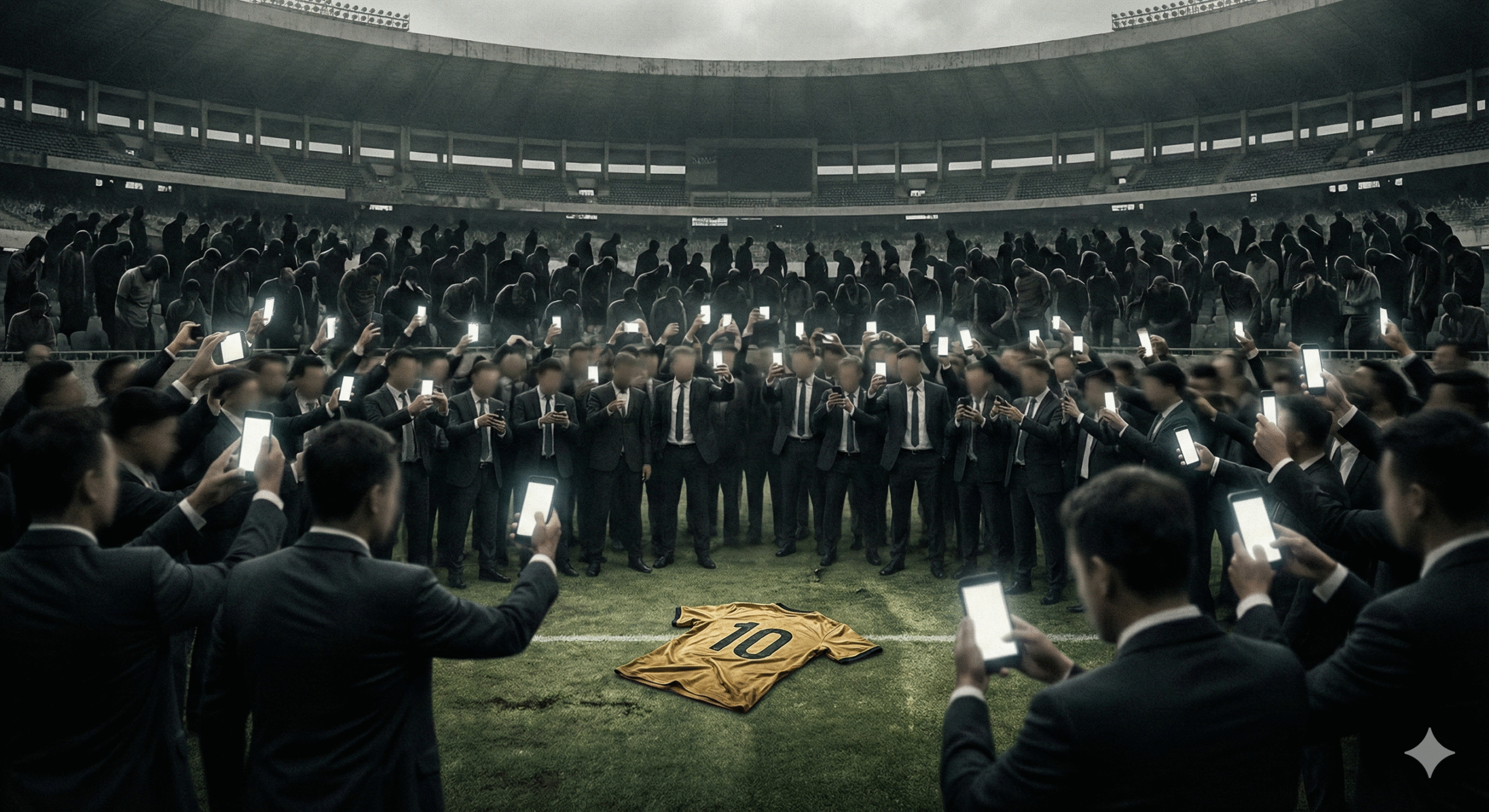
When Messi finally walked onto the pitch, the roar should have been deafening. Instead, it was confused. Why? Because the view of the legend was blocked. He was immediately swallowed by a swarm of middle-aged men in crisp white kurtas and formal suits.
The “Selfie” Ambush
“He looked like a trapped animal,” one observer noted.
This was not a security breach by crazy fans. This was a breach by “Important People.” Local politicians, committee members, sponsors, and their extended families flooded the designated safe zone. They didn’t want to shake his hand; they wanted content. They shoved phones in his face, grabbed his arm for photos, and ignored his visible discomfort. For 20 agonizing minutes, Messi wasn’t a guest; he was a prop.
This incident is not about football. It is a symptom of a specific Indian disease: **VIP Culture**.
In India, a “pass” is not just about access; it is a statement of power. The rules—stay behind the barricade, do not touch the athlete, respect personal space—are for the common man who paid for his ticket. For the person with “connections,” rules are merely suggestions.
We saw the same story during the Cricket World Cup ticket fiasco. We see it at every major concert where “special guests” block the front rows while true fans are pushed back. The tragedy of the Kolkata event was that the *protagonist* became the victim. The organizers forgot that the 85,000 people in the stands did not pay to see the local Corporator take a selfie; they paid to see Messi.
When a local official grabs a world icon by the shoulder to force a picture, he is not just embarrassing himself; he is signaling to the world that in India, entitlement outweighs achievement.
The aftermath was predictable. The main organizer, Satadru Dutta, is now facing intense scrutiny. The police are blaming the event management company. The politicians are blaming the police.
But let’s be honest: calling this “mismanagement” is too kind. It borders on fraud.
We are currently bidding to host the 2036 Olympics. We want to be a global sporting superpower. But ask yourself: After seeing clips of Messi being manhandled by a mob of officials, will Kylian Mbappé want to come here? Will Taylor Swift add India to her Eras Tour?
Global icons have a choice. They choose venues where they are safe, respected, and where the show runs on time. India offers passion—our fans are second to none. But our administration offers headaches.
The viral footage of Messi rushing off the pitch, surrounded by security trying to hold back “dignitaries,” reinforces every negative stereotype about India being chaotic and disorganized. We didn’t just fail Messi; we failed our own reputation. We confirmed the bias that we are a nation of great potential but terrible execution.
It is easy to blame the organizers and the politicians. But we must also look in the mirror.
As a society, we lack the discipline of distance. We confuse love with possession. We believe that if we see a celebrity, we own a piece of them. The fans who broke chairs and threw bottles because they were disappointed? They are part of the problem too. Destruction of public property is the final act of a society that has lost faith in civility.
If we ever want to host the World Cup or the Olympics, we need to banish the VIP culture from sports. The field belongs to the athletes. The stands belong to the fans. The politicians and organizers belong in the background, facilitating the magic, not stealing it.
The Final Whistle
Lionel Messi has likely left India for the last time. He will go back to Miami, to a league where he can walk into a grocery store without being mobbed. He will remember Kolkata not for the love of the 85,000 who screamed his name, but for the suffocating grip of the 50 who wouldn’t let him breathe.
We invited a god to our home, but we treated him like a prop for our vanity. We have the stadiums, we have the money, and we certainly have the passion. But until we learn to respect the art more than the selfie, we don’t deserve the stars.
Kolkata, we deserved better. But more importantly, Messi deserved better.