Artificial Intelligence is no longer a futuristic concept—it’s a part of our daily lives. From writing emails and generating images to coding applications and conducting research, AI tools have transformed how we work and learn.
With so many AI platforms available today, choosing the right one can be challenging. Some excel at coding, while others are better for content creation, research, or business productivity.
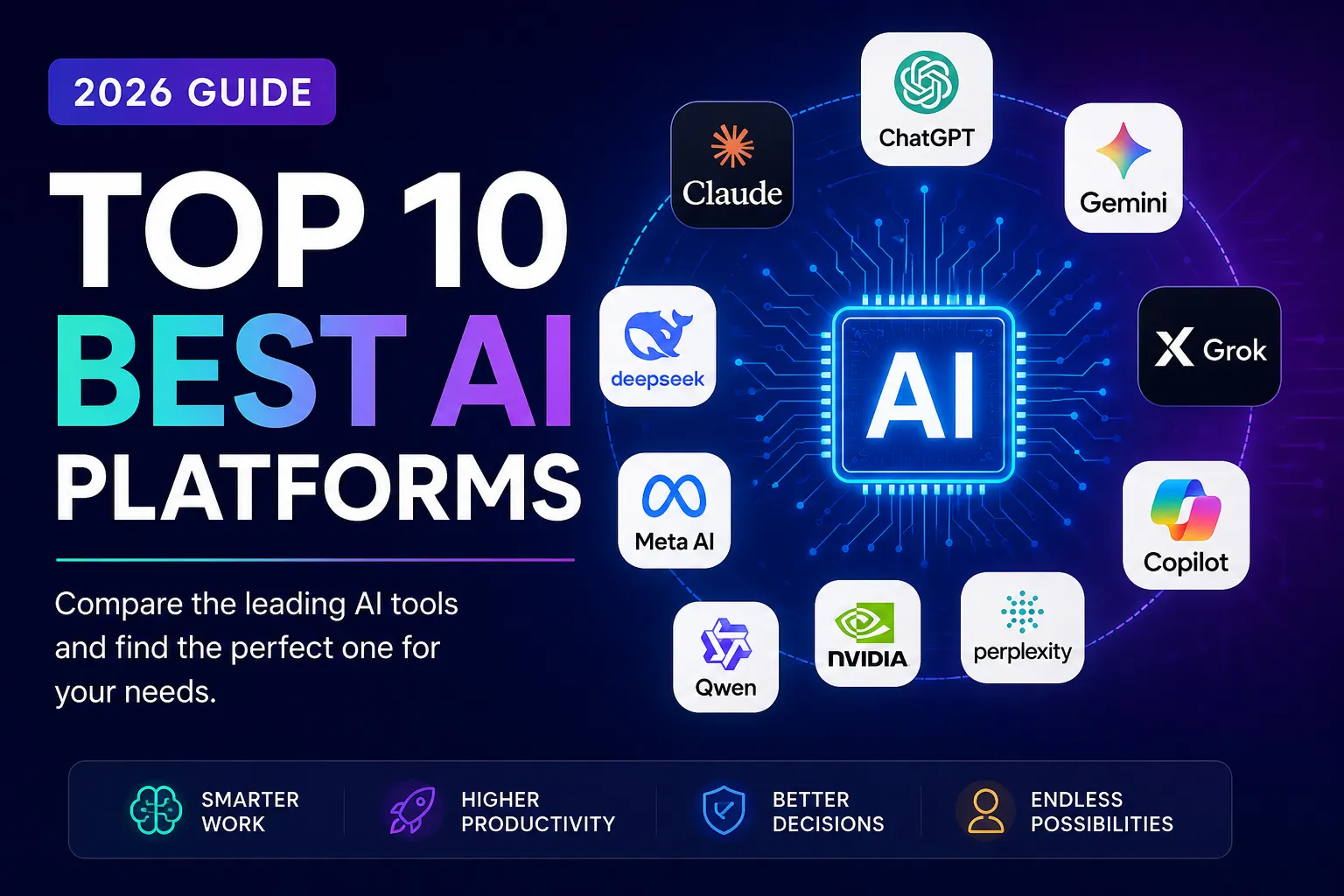
In this article, we’ll explore the top 10 AI platforms in 2026, ranked based on their capabilities, popularity, innovation, and real-world usefulness.
1. Claude AI
Claude AI has become one of the most advanced AI assistants available today. It is known for its strong reasoning abilities, long-context understanding, and human-like responses.
Best For:
- Content writing
- Research
- Programming
- Document analysis
Pros:
- Excellent reasoning capabilities
- Handles large documents efficiently
- Natural and conversational responses
Cons:
- Limited image generation compared to some competitors
2. ChatGPT
ChatGPT remains one of the most widely used AI platforms in the world. It offers a balance of creativity, coding assistance, research capabilities, and image generation.
Best For:
- Coding
- Learning
- Content creation
- Business productivity
Pros:
- User-friendly interface
- Strong coding support
- Image generation capabilities
- Large ecosystem of tools
Cons:
- Some advanced features require a paid plan
3. Gemini
Google’s Gemini has evolved into a powerful multimodal AI capable of understanding text, images, videos, and documents.
Best For:
- Research
- Productivity
- Google Workspace users
Pros:
- Deep integration with Google services
- Strong multimodal capabilities
- Fast information retrieval
Cons:
- Performance may vary across tasks
4. Grok
Developed by xAI, Grok has gained attention for its real-time internet access and conversational style.
Best For:
- Trending topics
- News analysis
- Social media insights
Pros:
- Access to current information
- Fast responses
- Unique conversational personality
Cons:
- Less mature ecosystem compared to competitors
5. Microsoft Copilot
Microsoft Copilot has become a valuable assistant for professionals working with Word, Excel, PowerPoint, and other Microsoft products.
Best For:
- Office productivity
- Business workflows
- Enterprise environments
Pros:
- Excellent Microsoft integration
- Productivity-focused features
- Enterprise security
Cons:
- Best experience requires Microsoft ecosystem
6. Perplexity AI
Perplexity AI has positioned itself as an AI-powered search engine that delivers direct answers with sources.
Best For:
- Research
- Fact-checking
- Academic work
Pros:
- Source-backed answers
- Fast research workflow
- Clean interface
Cons:
- Less creative than general-purpose chatbots
7. Meta AI
Meta AI continues to improve through the development of its open-source Llama models.
Best For:
- Open-source AI development
- AI experimentation
Pros:
- Open ecosystem
- Strong community support
- Rapid innovation
Cons:
- Not always the strongest consumer-facing experience
8. NVIDIA AI
NVIDIA has become a backbone of the AI industry, providing both AI infrastructure and advanced AI technologies.
Best For:
- AI development
- Machine learning projects
- Enterprise AI solutions
Pros:
- Industry-leading AI hardware
- Strong developer ecosystem
Cons:
- Primarily focused on developers and enterprises
9. Qwen
Qwen has emerged as one of the strongest AI models, particularly in coding, multilingual tasks, and open-source development.
Best For:
- Programming
- Technical work
- Open-source AI projects
Pros:
- Strong coding performance
- Multiple model options
- Growing popularity
Cons:
- Smaller ecosystem than larger competitors
10. DeepSeek
DeepSeek has rapidly gained recognition due to its impressive performance in mathematics, coding, and technical problem-solving.
Best For:
- Software development
- Mathematics
- Technical analysis
Pros:
- Excellent coding capabilities
- Cost-effective solutions
- Strong technical reasoning
Cons:
- Limited non-technical features
Final Thoughts
The “best” AI platform ultimately depends on your needs.
- For content creation and reasoning, Claude AI and ChatGPT are excellent choices.
- For research and information gathering, Perplexity AI and Gemini stand out.
- For developers, DeepSeek, Qwen, and ChatGPT offer powerful coding assistance.
- For businesses, Microsoft Copilot remains a strong productivity solution.
As AI continues to evolve, we can expect even more powerful tools that will further transform how we work, learn, and create. The future of AI is not just about automation—it’s about enhancing human potential and unlocking new possibilities.
Post Views: 33