Physical Address
Delhi, India
Physical Address
Delhi, India

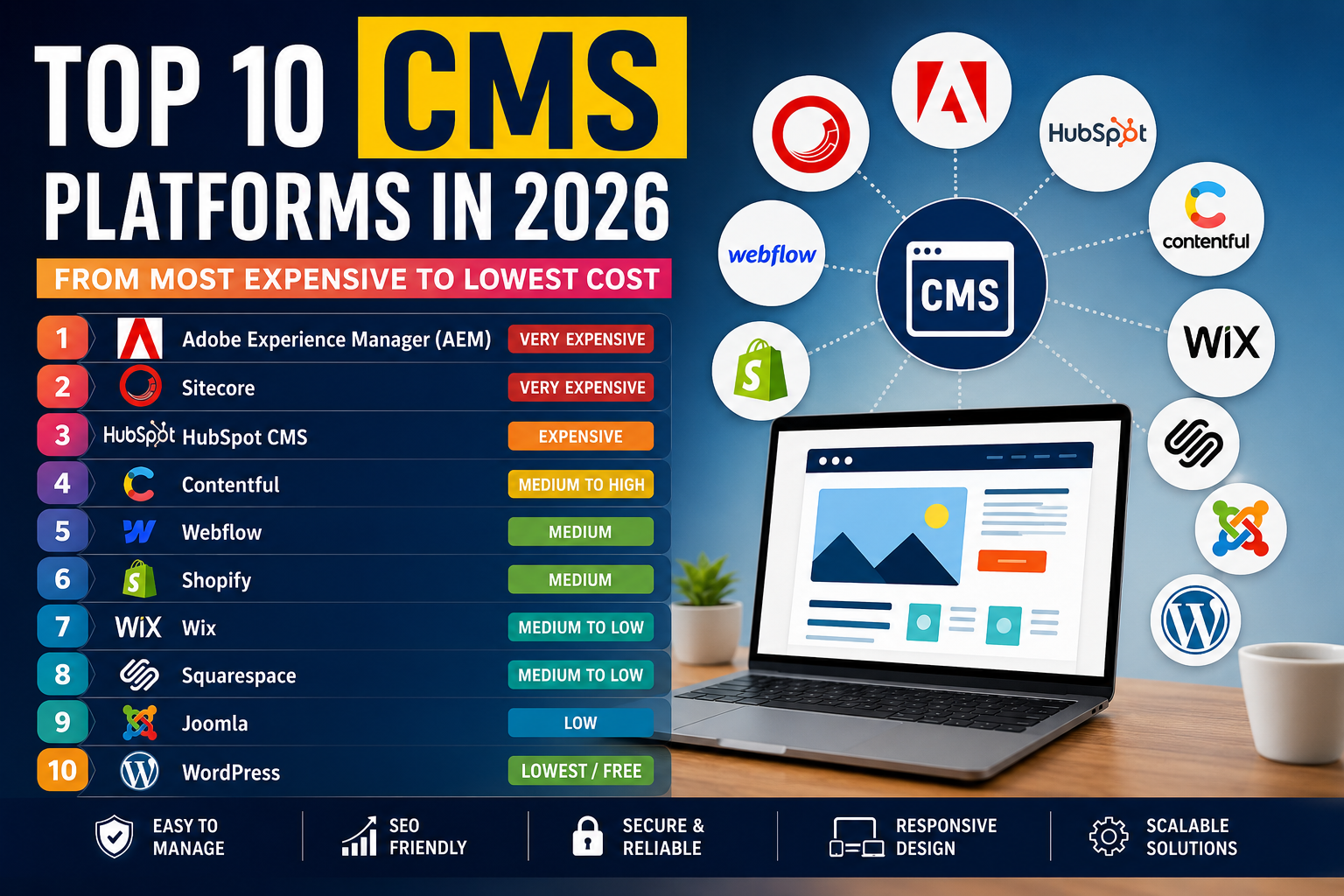
When someone plans to build a website, one of the first questions usually is: Which CMS should I choose?
Today, there are hundreds of CMS platforms available in the market. Some are built for large enterprises with huge budgets, while others are perfect for bloggers, startups, and small businesses.
In this article, we’ll look at the top 10 CMS platforms — starting from the most expensive enterprise solutions to affordable and beginner-friendly options.
With a CMS, you can:
A CMS (Content Management System) helps you create and manage a website without needing to code everything from scratch.
Some CMS platforms focus on marketing, some on ecommerce, and others on flexibility for developers.
Adobe Experience Manager is considered one of the most powerful enterprise CMS platforms available today.
Large companies use it because it offers advanced personalization, content management, and digital marketing features all in one system.
The biggest challenge is cost. AEM is extremely expensive and usually only suitable for large enterprises.
Official Website:
Adobe Experience Manager
Sitecore is another enterprise CMS platform focused heavily on customer experience and personalization.
It’s commonly used by large organizations that want detailed control over user journeys and marketing campaigns.
Setup and maintenance can be expensive and complex.
Official Website:
Sitecore
HubSpot CMS has become very popular among businesses and marketing teams.
What makes it different is that it combines:
All in one platform.
Pricing can feel high for small businesses or personal websites.
Official Website:
HubSpot CMS
Contentful is a modern headless CMS designed mainly for developers.
Instead of managing only websites, it allows content to be delivered across multiple platforms like:
Official Website:
Contentful
Webflow is loved by designers because it allows them to create beautiful websites visually without writing much code.
Official Website:
Webflow
Shopify is one of the best ecommerce CMS platforms in the world.
If your main goal is selling products online, Shopify makes the process simple.
Official Website:
Shopify
Wix is designed mainly for beginners who want to launch a website quickly.
Official Website:
Wix
Squarespace is known for its modern templates and elegant website designs.
Many creators and photographers prefer it because websites look visually polished without much effort.
Official Website:
Squarespace
Joomla is an open-source CMS that sits somewhere between WordPress and more advanced developer platforms.
It offers good flexibility but may require a little more technical understanding.
Official Website:
Joomla
WordPress is still the most popular CMS in the world.
One reason for its success is flexibility. Whether you want to build:
WordPress can handle almost everything.
You can start with very little budget.
Official Website:
WordPress
The right CMS depends on your goals and budget.
| Requirement | Recommended CMS |
|---|---|
| Enterprise business | Adobe Experience Manager |
| Marketing & CRM | HubSpot CMS |
| Ecommerce website | Shopify |
| Headless development | Contentful |
| Design-focused websites | Webflow |
| Budget-friendly websites | WordPress |
There’s no single “best” CMS for everyone.
Some businesses need enterprise-level tools with advanced personalization, while others simply need an affordable and easy-to-manage website platform.
If budget is not an issue, enterprise platforms like Adobe Experience Manager or Sitecore offer incredible features. But for most users, platforms like WordPress, Shopify, Webflow, or HubSpot provide the best balance between cost, usability, and performance.
The important thing is choosing a CMS that matches your: